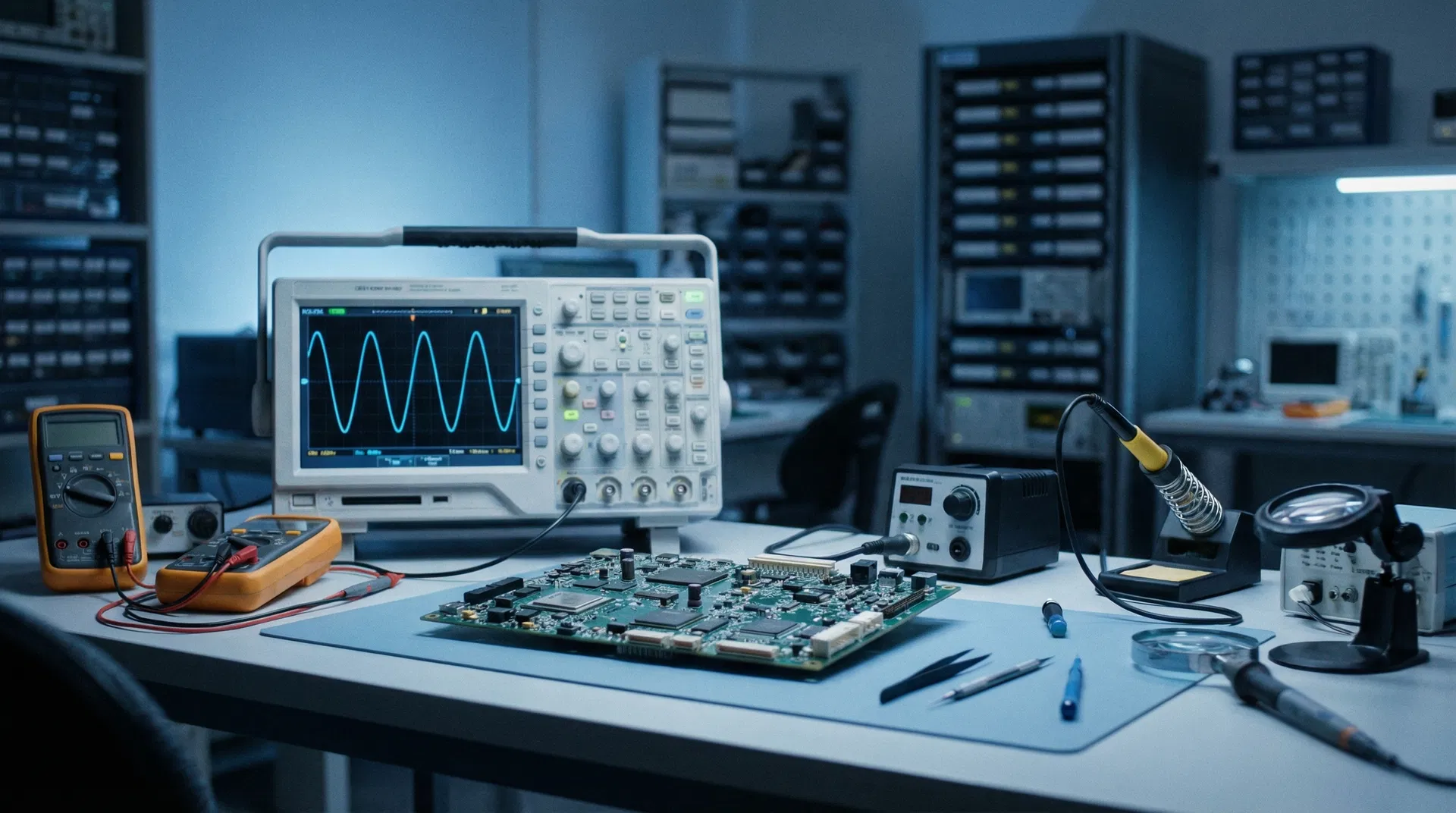
Low-noise design isn't just about following a set of rules—it's an art form that requires attention to detail and a deep understanding of your components and their interactions.
Insight from 25+ years designing safety-critical electronics in regulated environments.
Welcome to the wonderful world of low-noise design in precision analogue circuits. Whether you're designing cutting-edge medical devices, sensitive instrumentation, or high-fidelity audio equipment, minimising noise is crucial to achieving top-notch performance. At Hian Technologies, we've mastered the art of crafting ultra-quiet analogue circuits, and we're excited to share some of our insights with you. So, let's dive in!
Importance of Low Noise in Precision Analogue Circuits
Noise. It's the unwanted guest that crashes your party, the static on your favourite radio station. In the world of analogue circuits, noise can be a real performance killer. It distorts signals, reduces accuracy, and can even render your design useless in critical applications.
Imagine you're designing a medical device that needs to pick up tiny electrical signals from the human body. Or perhaps you're working on an audio amplifier where every decibel of clarity counts. In these scenarios, low noise isn't just desirable—it's absolutely essential.
Thermal Noise
Also known as Johnson-Nyquist noise, this is the random motion of electrons in a conductor, generating noise that's directly proportional to temperature. It's an unavoidable part of any resistive component.
Shot Noise
This occurs due to the discrete nature of the electric charge. In components like diodes and transistors, shot noise is caused by the random flow of electrons across a junction.
Flicker Noise
Also known as 1/f noise, this type becomes more significant at lower frequencies. It's commonly found in active devices like transistors.
External Noise Sources
Power supply noise, electromagnetic interference (EMI), and crosstalk from nearby circuits can all introduce unwanted noise into your system. Understanding these sources helps us to design circuits that minimise their impact.
Setting the Stage for Low-Noise Design
So, how do we get started on the path to low-noise nirvana? Here are a few foundational principles to keep in mind:
Component Selection
Choosing the right components is half the battle. Look for low-noise op-amps, resistors, and capacitors. At Hian Technologies, we have a knack for picking the perfect parts to keep noise at bay. Brands like Analog Devices and Texas Instruments have some excellent options. For example, the AD797 is a legendary low-noise op-amp, perfect for high-precision applications.
Power Supply Cleanliness
A noisy power supply can wreak havoc on your circuit. Ensure you have a stable, clean power source, and use filtering techniques to keep noise out.
PCB Layout and Grounding
A good layout can significantly reduce noise. Keep signal paths short, use ground planes, and separate noisy sections from sensitive ones.
Shielding and Filtering
Shielding can protect your circuit from external EMI, while filters can remove unwanted frequency components. By keeping these principles in mind, you're well on your way to designing precision analogue circuits with low noise performance.
Circuit Design and Layout Techniques
Let's get into the nitty-gritty of circuit design and layout techniques. This is where we can make a significant impact on noise performance. At Hian Technologies, we've honed these techniques to perfection.
Optimising Circuit Topology
First things first: the topology of your circuit. Choosing the right circuit topology can drastically reduce noise. Differential designs are your friends here. They reject common-mode noise, which is noise that appears identically on both inputs. This makes them much more resistant to external interference compared to single-ended designs.
For instance, in sensor applications, using a differential amplifier can help you achieve a higher signal-to-noise ratio. Differential pairs and balanced circuits are excellent choices for reducing noise and improving performance.
PCB Layout for Low Noise
Next up is the PCB layout. This is where the rubber meets the road. A well-designed PCB layout is crucial for minimising noise. Here are some key tips:
Use Ground Planes
A continuous ground plane helps to reduce electromagnetic interference (EMI) and provides a low-impedance path for return currents. Make sure to avoid splitting the ground plane under sensitive analogue sections.
Short Signal Paths
Keep your signal paths as short as possible. Long traces can act like antennas, picking up unwanted noise. Short, direct paths help maintain signal integrity.
Minimise Loop Areas
Loops in your circuit can pick up magnetic interference. Keep the area of any loops small to reduce susceptibility to noise.
Component Placement
Place sensitive analogue components away from noisy digital parts. Group similar components together to minimise interference and crosstalk.
Shielding and Filtering
Use metal enclosures or shielded cables to protect your circuits from external electromagnetic fields. Shielding is particularly important in environments with high EMI, such as industrial settings. Shieldings like the Harwin S02-20150300 work well in blocking unwanted external noise.
Practical Tips and Real-World Examples
Now that we've explored component selection and circuit design techniques, let's get down to the fun part: practical tips and real-world examples. At Hian Technologies, we live and breathe analogue design, and we're excited to share some of our field-tested strategies with you.
Case Study 1: High-Fidelity Audio Amplifier
One of our recent projects at Hian Technologies involved designing a high-fidelity audio amplifier. The challenge was to achieve an ultra-low noise floor to deliver the best sound quality possible. We started with an input stage using low-noise op-amps like the NJM2068, which are known for their excellent audio performance.
We carefully selected metal film resistors and polypropylene capacitors to minimise thermal and dielectric noise. The PCB layout was meticulously designed to keep signal paths short and separate analogue and digital grounds. The result? A crisp, clear audio output with minimal background noise, making it a hit among audiophiles.
Case Study 2: Precision Medical Device
Another interesting project involved a precision medical device for monitoring bioelectrical signals. The device needed to detect extremely small signals in the microvolt range, making noise performance absolutely critical. We used a combination of low-noise amplifiers and careful power supply design to provide a stable and clean voltage. Extensive filtering and shielding were employed to protect the sensitive analogue signals from external noise. This project underscored the importance of holistic design—every component and layout choice contributed to the device's exceptional performance.
Testing and Measuring Noise Performance
Once your design is complete, it's crucial to test and measure its noise performance. Here are some practical tips:
Use a Spectrum Analyser
A spectrum analyser can help you identify noise frequencies and amplitudes in your circuit. This tool is invaluable for pinpointing noise sources and verifying the effectiveness of your noise-reduction techniques.
Oscilloscope with FFT Function
An oscilloscope with a Fast Fourier Transform (FFT) function can provide a quick and easy way to visualise the frequency content of your signals, helping you identify and address noise issues in real time.
Stay Up to Date
Low-noise design is an evolving field. Stay current with the latest research, components, and techniques. Attend industry conferences, read technical papers, and keep an eye on new products from leading semiconductor manufacturers. New low-noise components and design techniques are continually being developed.
Consult the Experts
When in doubt, don't hesitate to seek expert advice. At Hian Technologies, our team of analogue design experts is always ready to help you tackle your toughest noise challenges. By applying these practical tips and learning from real-world examples, you can master the art of low-noise analogue circuit design.
Conclusion
And there you have it, fellow analogue enthusiasts! We've journeyed through the ins and outs of designing precision analogue circuits for low-noise performance. From understanding noise sources and selecting the right components to optimising circuit topology and PCB layout techniques, we've covered a lot of ground.
Remember, low-noise design isn't just about following a set of rules—it's an art form that requires attention to detail and a deep understanding of your components and their interactions. At Hian Technologies, we pride ourselves on being analogue design experts, and we're here to help you navigate these complexities with ease.
Whether you're working on high-fidelity audio systems, precision medical devices, or any other application where low noise is paramount, the tips and tricks we've shared can help you achieve superior performance. If you ever find yourself needing a bit of extra guidance, don't hesitate to reach out to us at Hian Technologies. We're passionate about pushing the boundaries of what's possible in analogue design, and we're always excited to collaborate with fellow innovators.
Thanks for joining us on this deep dive into low-noise design. Stay tuned for more insights, and happy designing!
References
- Horowitz, P., & Hill, W. (2015). The Art of Electronics (3rd ed.). Cambridge University Press.
- Motchenbacher, C. D., & Connelly, F. C. (1993). Low-Noise Electronic System Design. Wiley-Interscience.
- Gray, P. R., Hurst, P. J., Lewis, S. H., & Meyer, R. G. (2001). Analysis and Design of Analogue Integrated Circuits (4th ed.). Wiley.