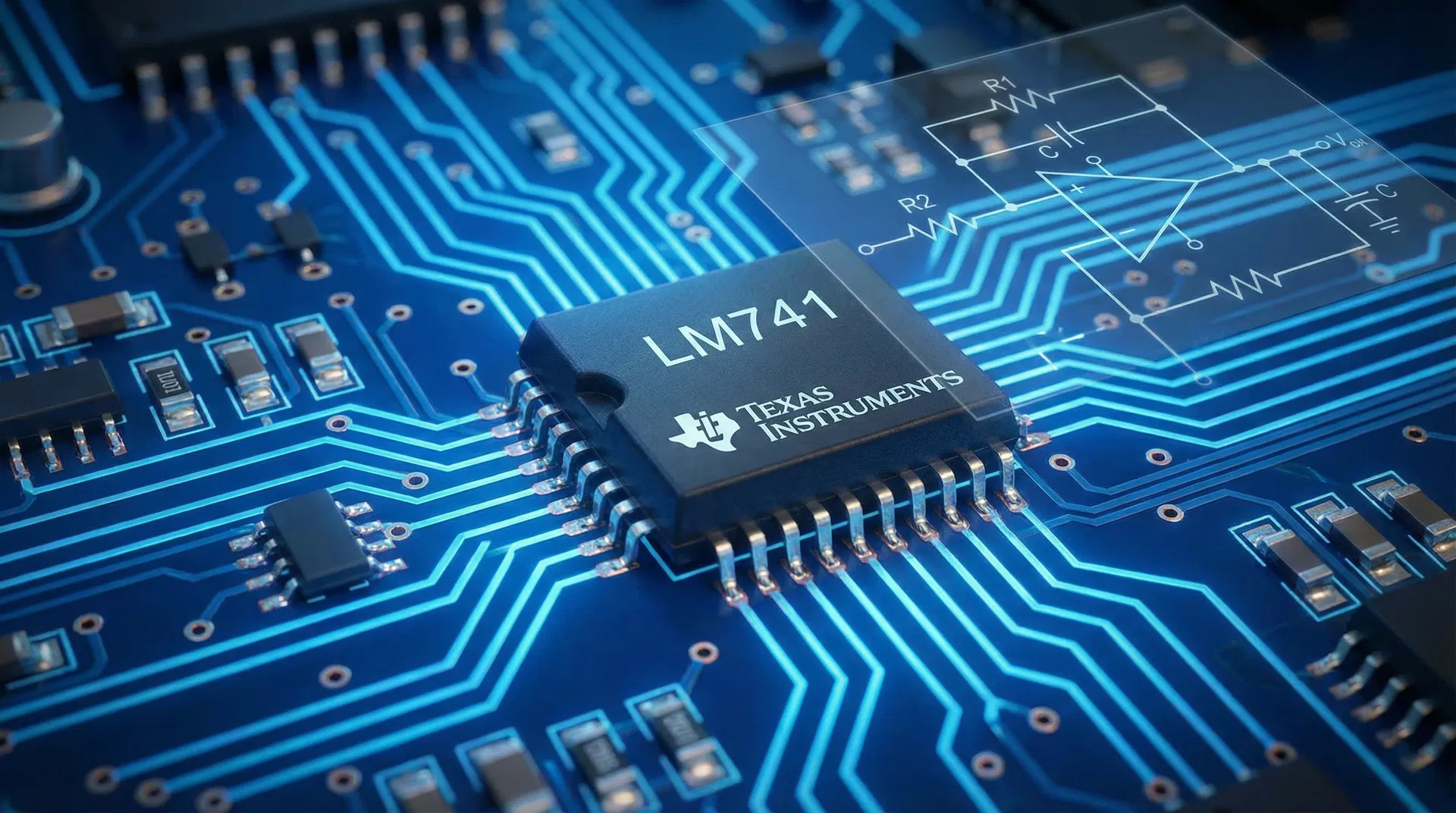
At Hian Technologies, our deep dive into the operational amplifier's lesser-known abilities is more than just technical expertise—it's a passion for pushing the boundaries of what's possible in analogue electronics design.
Insight from 25+ years designing safety-critical electronics in regulated environments.
Floating Op-Amps: Breaking the Ground Barrier
In the realm of electronics design, sometimes the most revolutionary ideas begin by rethinking fundamental concepts. One such concept is the way we use operational amplifiers, commonly tied down by ground-referenced power supplies. However, at Hian Technologies, we often go beyond this conventional approach by employing a technique known as op-amp "floating".
Floating an op-amp means that instead of grounding the power supply, it's isolated, allowing the device to effectively function in much higher voltage environments far beyond its normal capability. This method is particularly valuable in applications like high-voltage test equipment and precision measurement systems, where maintaining ground isolation is crucial. It prevents ground loops, which can introduce errors and interference, thus improving measurement accuracy and reliability.
Furthermore, floating op-amps can properly handle voltages that significantly exceed the nominal power supply levels. This ability to handle higher voltages isn't just about versatility; it's about opening doors to new possibilities in circuit design, allowing our engineers at Hian Technologies to innovate and create more robust, flexible, and capable electronic products. By mastering such techniques, we ensure that our designs not only meet but exceed the rigorous demands of modern electronics applications.
Parasitic Capacitance: The Ghost in the Machine
Parasitic capacitance in operational amplifiers is a subtle yet omnipresent problem that can lurk even in the most meticulously designed circuits. These unwanted capacitive effects are like ghosts haunting within the machine, emerging particularly at higher frequencies where their influence becomes significantly more pronounced. At Hian Technologies, we've become experts at managing these spectral challenges to enhance circuit performance and stability.
The origin of parasitic capacitance is rooted in the physical construction of the op-amp itself. Components like the input and output pins, and even the circuit board layout, can introduce these capacitances, which form unwanted feedback paths for the signal. This can lead to oscillations or noise amplification, undermining the op-amp's ability to function properly in precision applications.
To combat these effects, our engineers employ several strategies, including careful layout design to minimise trace lengths and shield sensitive components. Additionally, we use specialised circuit techniques to balance and compensate for these parasitic elements. By incorporating feedback networks and selecting components with inherently lower capacitances, we can effectively dampen the influence of these parasitic paths.
Our commitment at Hian Technologies to mastering these intricate details not only solves immediate design challenges but also pushes the boundaries of what's possible in high-frequency and high-precision analogue electronics. This expertise ensures that our clients receive products that operate reliably and exceed expectations even in the most demanding applications.
Input Bias Current Compensation: The Quest for Perfection
In the precision world of electronic circuit design, the devil is often in the details, and one such critical detail is input bias current in operational amplifiers. At Hian Technologies, we understand that even the tiniest currents can lead to significant errors, especially in high-precision applications. That's why mastering input bias current compensation isn't just a practice—it's a quest for perfection in our designs.
Input bias current refers to the small amount of current that flows into the input terminals of an op-amp, a fundamental characteristic inherent to the physics of the transistors within. Although typically small, this current can cause significant voltage drops across any resistive component connected to the input terminals, thus introducing errors in voltage measurement and signal processing.
To counteract this, our engineers at Hian Technologies employ several advanced techniques. One common method is the inclusion of balance resistors in the input stage. By inserting equal-value resistors in series with each input terminal, we create a symmetric path for the bias current, thus nullifying the voltage drop across each resistor.
Additionally, we also utilise feedback mechanisms and careful circuit design planning to minimise the impact of bias currents, ensuring that our circuits remain accurate and stable under all operating conditions. This meticulous attention to detail underscores our commitment to delivering electronics that achieve the highest standards of reliability and precision.
Thermal Feedback: Staying Cool Under Pressure
At Hian Technologies, we recognise that thermal effects in operational amplifiers can subtly undermine circuit performance, which is why we emphasise thermal management in our designs. When op-amps process signals, they dissipate power, which can lead to a rise in chip temperature. This temperature increase can, in turn, affect key op-amp parameters like offset voltage and gain, leading to potential performance drift.
In the world of operational amplifiers, "thermal feedback" is about how temperature changes affect op-amp performance. As the inside of an op-amp heats up, the behaviour of its parts (like transistors and resistors) begins to change. This can affect how the op-amp functions.
Component Sensitivity
Things like the transistors inside the op-amp react to heat by behaving differently. For example, a transistor might allow more current when it heats up, which can affect the op-amp's output and its overall effectiveness.
Feedback Loop
If these temperature changes make the op-amp heat up more, which then changes its behaviour even more, you have a feedback loop. This can make things unstable if it gets too hot.
Performance Impact
The biggest issue with thermal feedback is that it can compromise the stability and accuracy of the op-amp. In setups where precision is key, even a small temperature change can lead to big problems with signal quality.
Heat Dissipation
At Hian Technologies, we employ heat sinks on operational amplifiers. Not only do they dissipate heat effectively, but with our expert PCB designs that promote better airflow, your op-amps won't overheat. It's about staying cool to keep your circuit stable.
Picky with Parts
Our team at Hian Technologies selects resistors, transistors, and other components that are resilient against temperature variations. By choosing the right parts, your op-amps are set to withstand the heat, maintaining top-notch reliability.
Smart Circuit Design
This is where we get clever with circuit designs. Incorporating thermal compensation isn't just a tweak—it's a game-changer. Our designs include elements that adjust themselves as temperatures change, ensuring that your op-amp's output remains as stable as possible. For example, we can use the contour-line technique (Microchip Application Note AN1258).
Subthreshold Operation: Powering the Future
In an era where energy efficiency is paramount, Hian Technologies is at the forefront of harnessing the power of subthreshold operation in operational amplifiers. This technique, though complex, is crucial for applications where conserving power is as important as performance: think wearable technology, IoT devices, and medical implants, where battery life is critical.
Subthreshold operation involves running the MOS transistors within an op-amp at voltage levels below their threshold for strong inversion. In this region, the transistors aren't fully turned on; instead, they operate in what's known as weak inversion mode. This mode allows current to flow at a significantly reduced rate compared to above-threshold operation, leading to drastically lower power consumption.
However, operating in the subthreshold region isn't without challenges. The reduced current levels mean slower operating speeds and increased susceptibility to noise, factors that are often detrimental in fast and high-precision applications. But at Hian Technologies, we've refined the balance between power efficiency and performance. Through innovative circuit design and cutting-edge technology, we optimise these op-amps to deliver sufficient speed and reliability for their intended applications.
Furthermore, our engineers employ advanced techniques such as adaptive biasing and optimised feedback mechanisms to enhance the stability and functionality of op-amps in subthreshold operation. By pushing the boundaries of traditional design, Hian Technologies not only contributes to more sustainable electronics but also enables new possibilities in power-sensitive applications. This commitment to innovation underscores our role as a leader in cutting-edge electronic design, where every microwatt of power savings counts towards a bigger environmental impact.
Wrapping Up
At Hian Technologies, our deep dive into the operational amplifier's lesser-known abilities is more than just technical expertise: it's a passion for pushing the boundaries of what's possible in analogue electronics design. Our work with op-amps is a testament to our commitment to innovation and excellence.
Interested in innovative electronic design solutions? Connect with us at Hian Technologies, where we turn complex challenges into streamlined, cutting-edge designs. Stay tuned for more insights and explorations into the fascinating world of electronics!
References
- Analog Devices. (2023). Op Amp Applications Handbook. Retrieved from https://www.analog.com
- Texas Instruments. (2023). Op Amp Design Techniques. Retrieved from https://www.ti.com
- Gray, P. R., Hurst, P. J., Lewis, S. H., & Meyer, R. G. (2001). Analysis and Design of Analogue Integrated Circuits (4th ed.). Wiley.